It’s Bigger Than Soccer: Why Americans Have Fallen for the World Cup
I am not a big sports person. I often call any type of sporting event "sportsball," partly as a joke and partly because I usually have no idea what is happening... and I typically don't care to know.
Soccer is the exception. I played for many years growing up, so I understand the game and can usually tell when someone has done something impressive. Typically, I don't keep up with it, other than in 2019 when the US Women's National Team won the Cup for the fourth time. (That's four World Cup titles more than the US Men's National Team, for anyone keeping score.)
Even so, I did not expect to become particularly invested in this year's World Cup.
Soccer is, by far, the world's most popular sport. Yet in the United States, it has traditionally taken a backseat to football, basketball, baseball, and even hockey. That makes the excitement surrounding this tournament feel especially noticeable.
When the World Cup arrived in North America, it suddenly felt much closer to home. Living near Atlanta, one of the host cities, made that especially true. Fan festivals were happening nearby. International visitors were posting videos about their experiences in the United States. My social media feeds filled with flags, songs, jerseys, celebrations, cultural exchanges, dramatic wins, heartbreaking losses, and Americans trying to learn soccer in real time. I attended a FIFA Fan Festival myself, and I loved it.
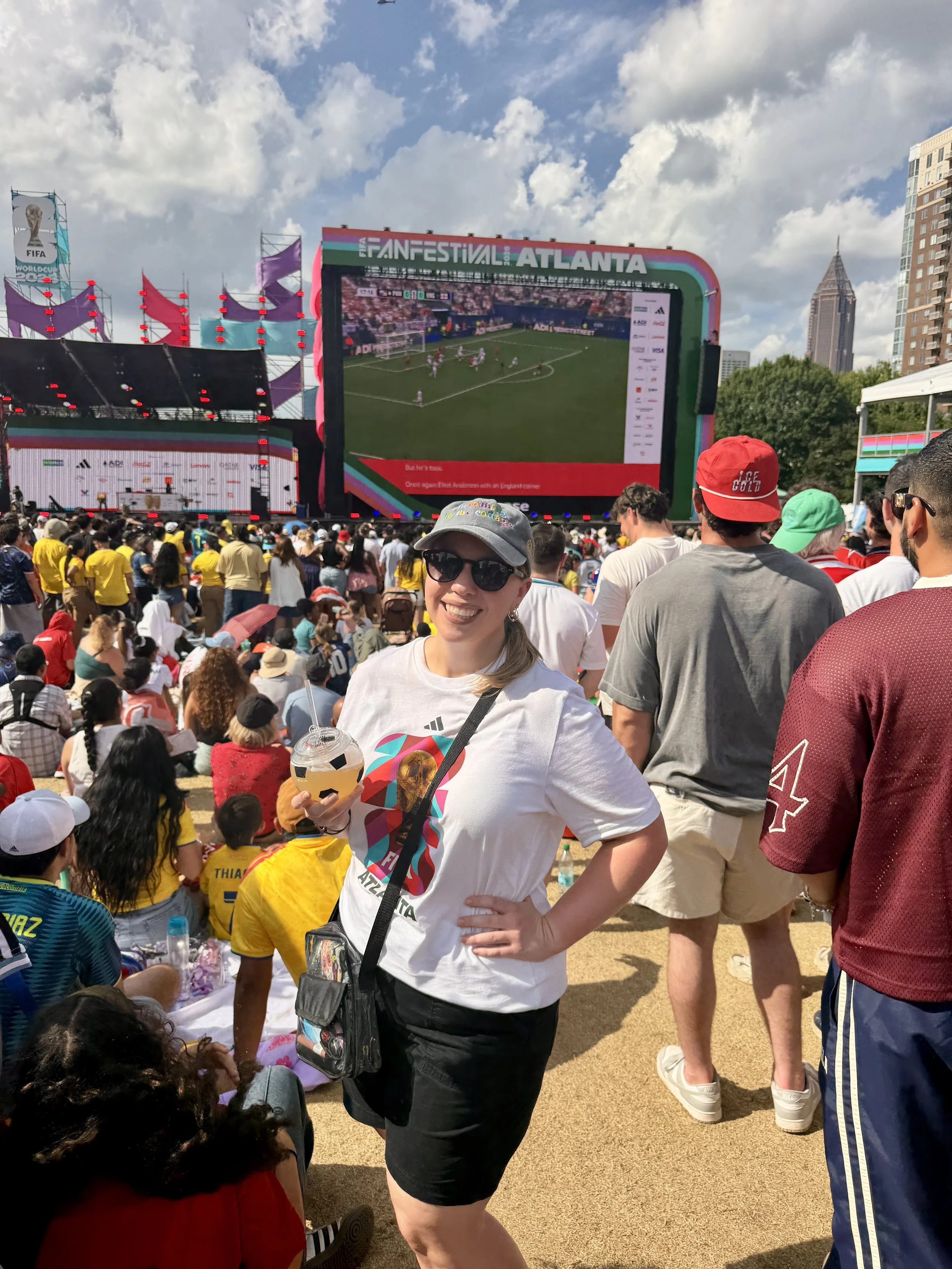
Me (Meredith, LPC) at a FIFA Fan Festival event in Atlanta
Pretty quickly, it was evident that I wasn't the only American who had unexpectedly become invested.
So why are so many Americans suddenly excited about the World Cup?
Part of the answer is obvious. We are hosting it. But I think something deeper is happening too.
The World Cup gives people a chance to belong to something joyful, communal, international, and bigger than themselves. At a time when Americans are constantly reminded of everything dividing us, the tournament has created a rare opportunity to gather around connection, curiosity, and fun.
It may technically be sportsball, but it is also a massive global exercise in human belonging.
Hosting Makes the World Cup Feel Personal
It is one thing to watch a major international event happening thousands of miles away. It is another to realize that fans from around the world are arriving in your city, eating at restaurants you recognize, navigating American public transportation, and celebrating in streets you may have driven down last week.
Hosting makes the tournament feel tangible.
Even people without tickets can participate. They can attend fan festivals, join public watch parties, visit businesses filled with international supporters, or simply follow the celebrations online.
The proximity changes our relationship with the event. The World Cup is not just happening somewhere. It is happening here.
Local news covers it. Businesses decorate for it. Friends talk about it. People wear jerseys to the grocery store. Social media notices that you paused for three seconds on a video of Scottish fans playing bagpipes and decides soccer is now your entire personality.
Participation becomes easier because the experience comes to us.
Americans Are Craving Shared Experiences
We live in an age of individualized entertainment.
We stream shows at different times. We follow different social media feeds. We listen to different podcasts. Even when several people watch the same series, they may be on completely different episodes and have to negotiate spoilers before having a conversation.
The World Cup cuts through that.
A match happens at a specific time. Millions of people watch it together. For about 90 minutes, they are reacting to the same thing at the same time. That kind of shared attention has become increasingly rare.
Psychologists and sociologists sometimes use the term “collective effervescence” to describe the emotional energy that develops when people participate in a shared experience. In sports settings, chanting, cheering, singing, wearing team colors, and reacting together can strengthen a sense of connection.
You do not have to know the people around you. You may have nothing else in common with them. But when your team scores, everyone jumps up at once.
For a moment, strangers feel less like strangers.
People hug. They high-five. They yell things they would never normally yell in public. Imagine walking into a coffee shop and screaming because someone successfully completed a work assignment. Security might get involved. At a World Cup watch party, this is appropriate behavior.
Sports create permission for people to express excitement, hope, disappointment, and connection openly. That release feels rewarding.
The World Cup Offers a Clear Sense of Belonging
Humans have a basic psychological need to belong. We want to know who our people are and where we fit.
Sports fandom offers an accessible form of group identity. You put on a jersey, learn a chant, recognize a flag, and suddenly you are part of something.
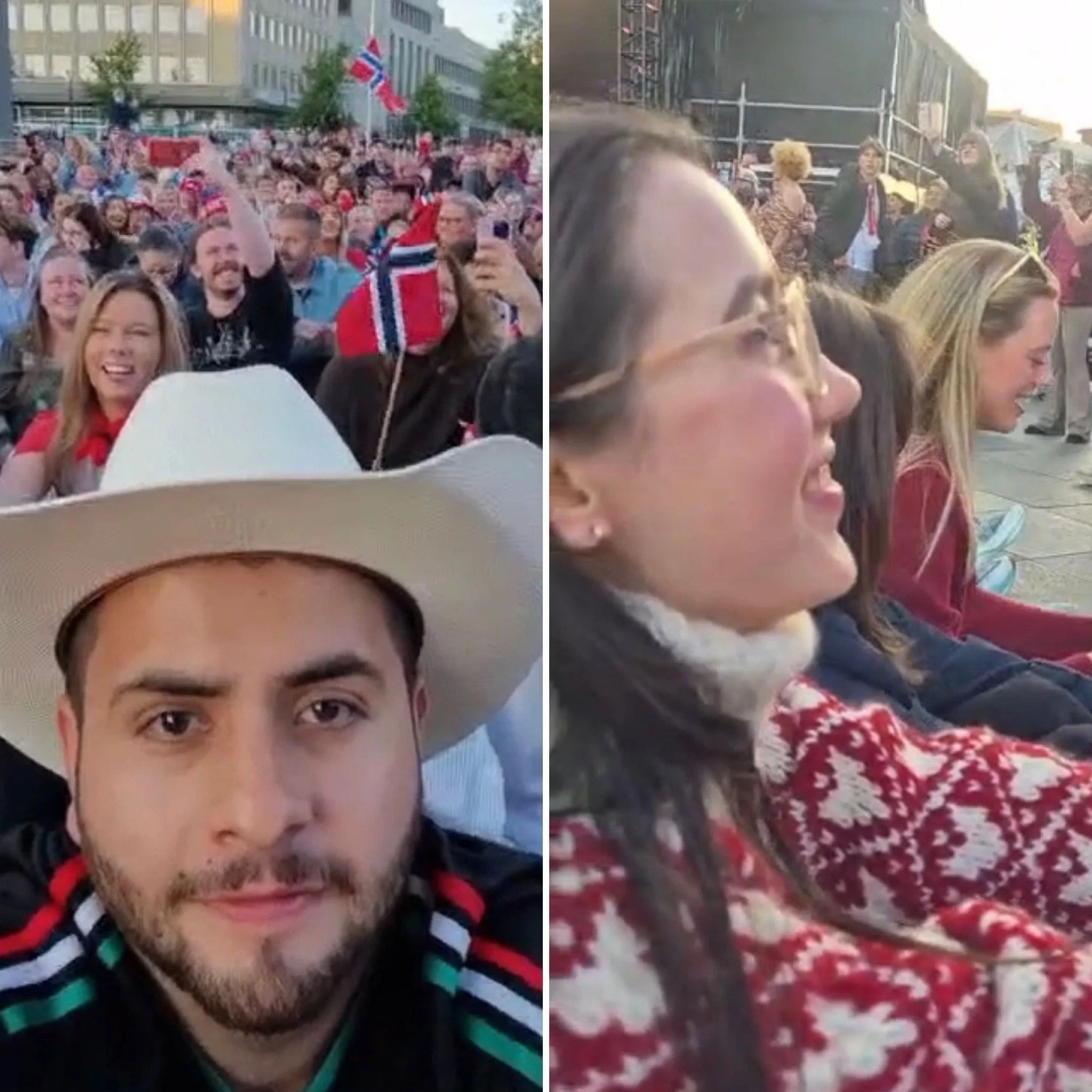
My half brother, who has American and Mexican heritage (wearing a Mexico jersey), and my sister-in-law, who has Norwegian and Vietnamese heritage, joining the Viking Row at a watch party in Norway
National teams add another layer because they connect fandom to culture, family history, immigration, geography, and heritage.
Some fans support the country where they live. Others support the country where they were born, where their parents were born, or where generations of their family lived. Some support more than one team. Some adopt a temporary team after theirs is eliminated. Others choose based on a favorite player (Haaland, anyone?!), a lovable fan base, an inspiring underdog story, or a uniform they like. Personally, I tend to support the countries where I’ve traveled.
All of these are valid ways to participate.
For immigrants and multicultural families, the tournament can also create a meaningful bridge between identities.
A person can feel deeply American while also celebrating Mexican, Colombian, Korean, Haitian, Ghanaian, or Croatian heritage. The World Cup gives people a visible way to honor parts of their identity that may not always show up in everyday life.
Identity is rarely as simple as one flag. The tournament makes that complexity visible.
Multiculturalism Becomes Something We Experience
One of my favorite parts of this World Cup has had very little to do with the games. I have loved the social media posts from visiting fans.
Fans from other countries have shared their reactions to American cities, food, stores, hospitality, landscapes, traditions, and everyday life. Some are going to Waffle House. Some are exploring new cities. Some are discovering the emotional and financial dangers of entering Target without a shopping list. Some are smuggling ranch dressing through international airports.
The videos are fun, but they also do something meaningful. They allow Americans to see familiar places through someone else's eyes. A grocery store, restaurant, neighborhood, or city that feels ordinary to us becomes interesting again when viewed by a visitor.
They also introduce Americans to people from countries they may otherwise encounter mostly through headlines, stereotypes, political debate, or not at all. Instead of seeing an abstract category like "foreign visitors," we see actual people.
We see humor, curiosity, disappointment, generosity, excitement, and nervousness. We watch people sing, dance, try unfamiliar food, get confused by our portion sizes, and celebrate with strangers. That kind of exposure can make the world feel smaller in the best way.
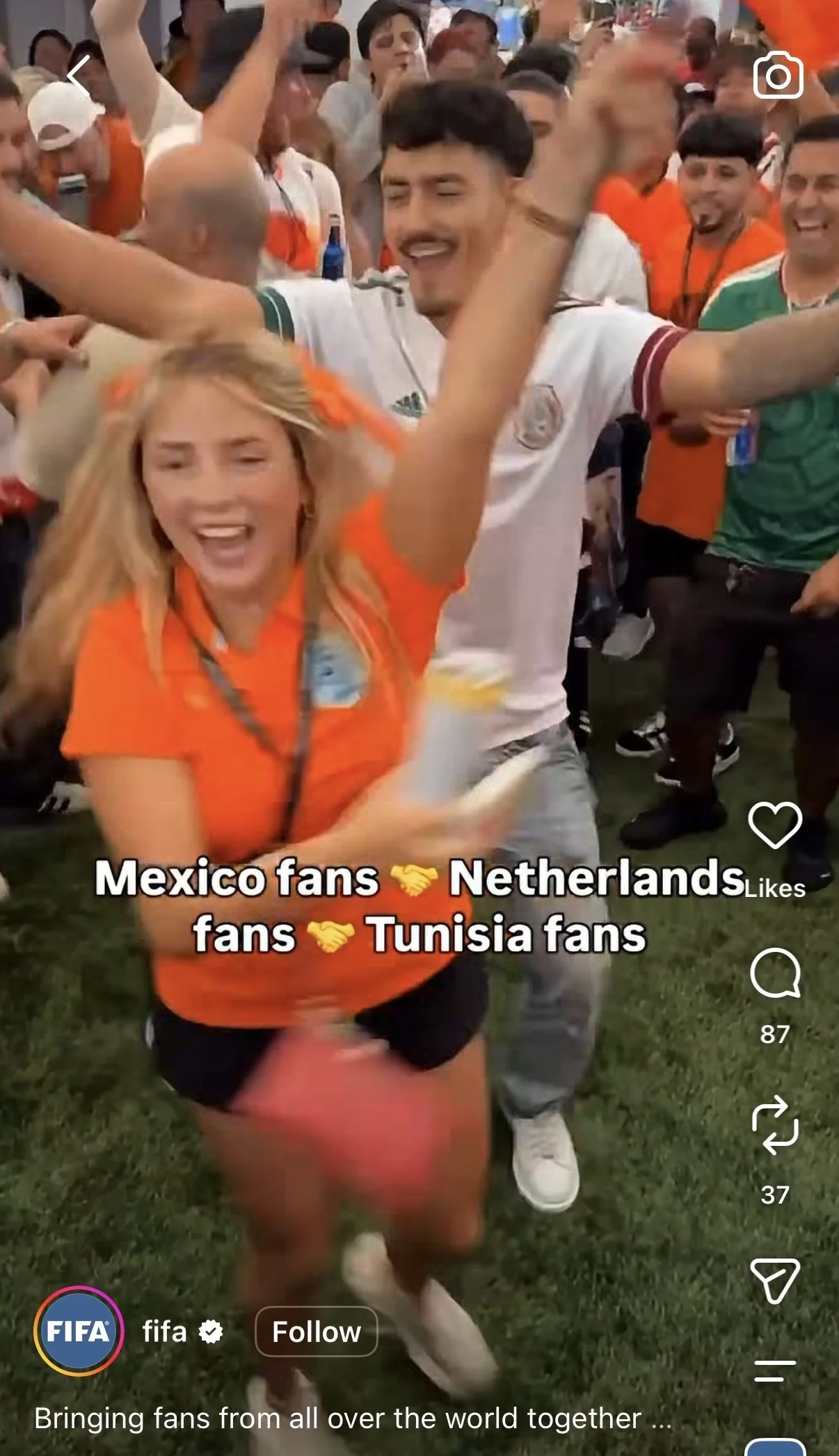
FIFA shared this Reel highlighting fans from different countries sharing in the joy of the tournament together. Click the image to watch the original post on Instagram.
One reason the World Cup feels so refreshing is that it encourages us to see people as people instead of stereotypes. Psychologists have long found that positive contact between different groups can reduce prejudice and build empathy. It becomes harder to reduce people to stereotypes after watching them dance in a parking lot, compliment someone's cooking, or marvel at the sheer size of an American Walmart.
Multiculturalism is often discussed as if it is an abstract political idea. In reality, it is usually built through ordinary human interaction. People eat together. They work together. Their children play together. They attend events together. They celebrate together.
Of course, a soccer tournament cannot eliminate xenophobia, racism, nationalism, or political division.
It is also important to acknowledge that not everyone has been equally able to participate in this World Cup. Concerns about visas, travel restrictions, and exclusion matter, especially during an event built around international unity. We should be able to enjoy the beauty of a multicultural celebration while also questioning the policies and systems that keep some people out.
That contradiction makes the value of multiculturalism even more important.
The most meaningful version of multiculturalism is not simply enjoying what other cultures produce. It is respecting the people within those cultures.
The World Cup reminds us that people can maintain distinct identities, traditions, histories, and loyalties while sharing the same space.
Difference does not have to be threatening. Sometimes difference is exactly what makes the gathering so much fun.
A World Cup made up of one country would be a very short and confusing tournament.
The World Cup Offers a Different Kind of Patriotism
American patriotism is often framed in rigid terms. It can become tied to political identity, military power, or the idea that loving your country requires ignoring its problems.
The World Cup offers another possibility.
People can cheer for the United States while also welcoming other countries. They can feel pride in their home without believing everyone else is inferior. They can celebrate American culture while enjoying what international fans bring with them.
This is patriotism rooted in hospitality rather than superiority.
Many of the most popular stories from the tournament have focused on Americans welcoming visiting fans and international supporters sharing positive experiences of local communities. That kind of national pride builds connection instead of division.
Not, “We are the only country that matters.” More like, “Welcome. We are glad you are here. Please try the barbecue, but prepare yourself for the serving size.”
A healthy national identity does not require hostility toward outsiders. It can include confidence, curiosity, generosity, and self-reflection. We can love where we come from and still believe that other people’s homes, languages, traditions, and histories have equal value.
Social Media Has Turned the Tournament Into a Global Story
Previous generations experienced the World Cup mainly through matches, news coverage, and local gatherings.
Now, the tournament unfolds through millions of individual perspectives.
We see social media footage from airports, restaurants, sidewalks, fan festivals, train stations, hotels, and living rooms. We meet fans before we see their teams play. We learn their songs. We follow people traveling from city to city. We watch them try American food or figure out our transportation systems.
The tournament becomes a global story with thousands of characters. That is especially appealing to people who may not care much about soccer tactics but love travel, culture, humor, human-interest stories, fashion, food, or community.
In other words, the World Cup no longer belongs only to people who can explain every position on the field. It also belongs to those who are interested in the fans, friendships, outfits, emotional backstories, and whether everyone is staying hydrated.
You can enter through whichever door interests you. Eventually, you may even find yourself watching an entire match.
The Tournament Gives Us Something to Look Forward To
Mental health is not only supported by what we enjoy in the moment. It can also benefit from having something to anticipate. Positive psychology has long recognized that having meaningful experiences to look forward to can be an important part of well-being.
Just check out Japanese fan Hirochika Nakakuki. His enthusiasm is contagious, and if nothing else, it's a great reminder that letting yourself get excited about something can be good for your well-being.
The World Cup creates weeks of anticipation. People plan watch parties. They compare schedules. They learn about teams. They buy jerseys. They text friends after dramatic matches. They speculate about what might happen next.
Anticipation gives structure to time. A stressful week may still include a game on Saturday. A difficult day may end with meeting friends at a fan event. Even a loss creates a conversation, a memory, and eventually another tournament.
Sports and fandoms do not replace meaningful mental health support. However, social connection, positive anticipation, recreation, and enjoyable rituals can all serve as protective factors, meaning they can support well-being and help people cope with stress.
Joy matters. Fun matters. Having something harmless to care about matters.
Not every meaningful experience has to be productive or life changing. Sometimes it is enough to gather with other people and hope someone kicks a ball in the correct direction.
We Are Not Only Watching Soccer. We Are Watching People Connect.
I still do not consider myself a major sports fan. Once the World Cup ends, I am unlikely to organize my life around league schedules. I will return to calling all athletic events sportsball, whether it involves a ball or not. (Hockey? Sportsball. Track and field? Sportsball.)
But I will remember the atmosphere. I will remember attending a FIFA Fan Festival and seeing people from all over the world gathered around a shared experience. I will remember the posts from visiting fans. I will remember the flags, music, humor, cultural pride, and moments of unexpected connection.
That is the real reason I think so many Americans have become excited about the World Cup.
Hosting has made the tournament visible and accessible, but soccer alone does not fully explain the emotional response.
The World Cup arrived during a period of deep political division, social isolation, and anxiety about what it means to belong in the United States.
Then millions of people from different countries appeared in the same cities wearing different colors, singing different songs, celebrating side by side, and appreciating what we have to offer.
For a few weeks, multiculturalism was not just an argument or an aspiration. It was visible in the streets.
The tournament reminded us that community does not require sameness. People can be proud of where they come from while remaining curious about everyone else. We can cheer for different teams and still enjoy the same gathering.
We can care about our own country without closing ourselves off from the world.
And sometimes, even those of us who prefer the highly technical term “sportsball” can discover that a sporting event is about much more than sports.
Sometimes it is about the human need to gather, belong, celebrate, and feel connected to something bigger than ourselves.
It may even be worth learning the offside rule. Again.
If you're looking to build more connection, joy, or belonging in your own life, therapy can be a great place to start. You can learn more about working with me here.
More Articles:
When Your Hero Lets You Down: Coping with Celebrity Disappointment
Book Review: Man’s Search for Meaning and What It Teaches Us About Mental Health
Feeling Overwhelmed by Politics? How Therapy Can Help You Cope with Political Stress
Why We Cry Over Fictional Deaths: The Science of Emotional Attachment in Fandom
What Companies Can Do to Support Employee Mental Health (And Why It Matters)
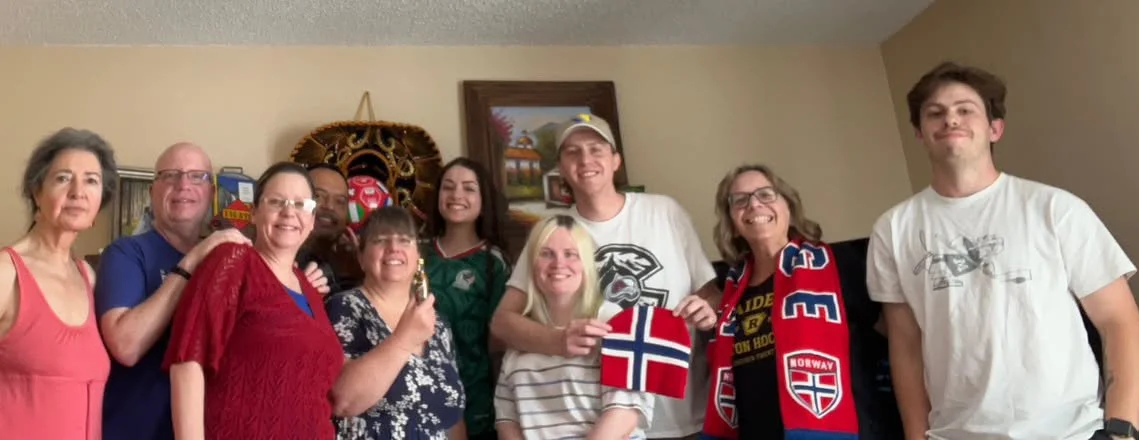
Extended family supporting both Norway and Mexico because of their family ties (plus a shout out to the fictional Boston Raiders hockey team!)