The Karpman Drama Triangle: Why You Keep Getting Pulled Into the Same Relationship Patterns (and How to Get Out)
If you’ve ever walked away from a conversation thinking, How did that escalate so quickly? or Why do I always end up feeling responsible for everyone else? you’re not alone. Many people find themselves stuck in repeating interpersonal patterns that feel confusing, draining, and hard to break.
One framework that helps make sense of this is the Karpman Drama Triangle. It’s a simple but powerful way to understand the roles we unconsciously fall into during conflict or emotional distress and why those roles keep us stuck.
Let’s break it down in a way that actually feels usable in real life.
What Is the Karpman Drama Triangle?
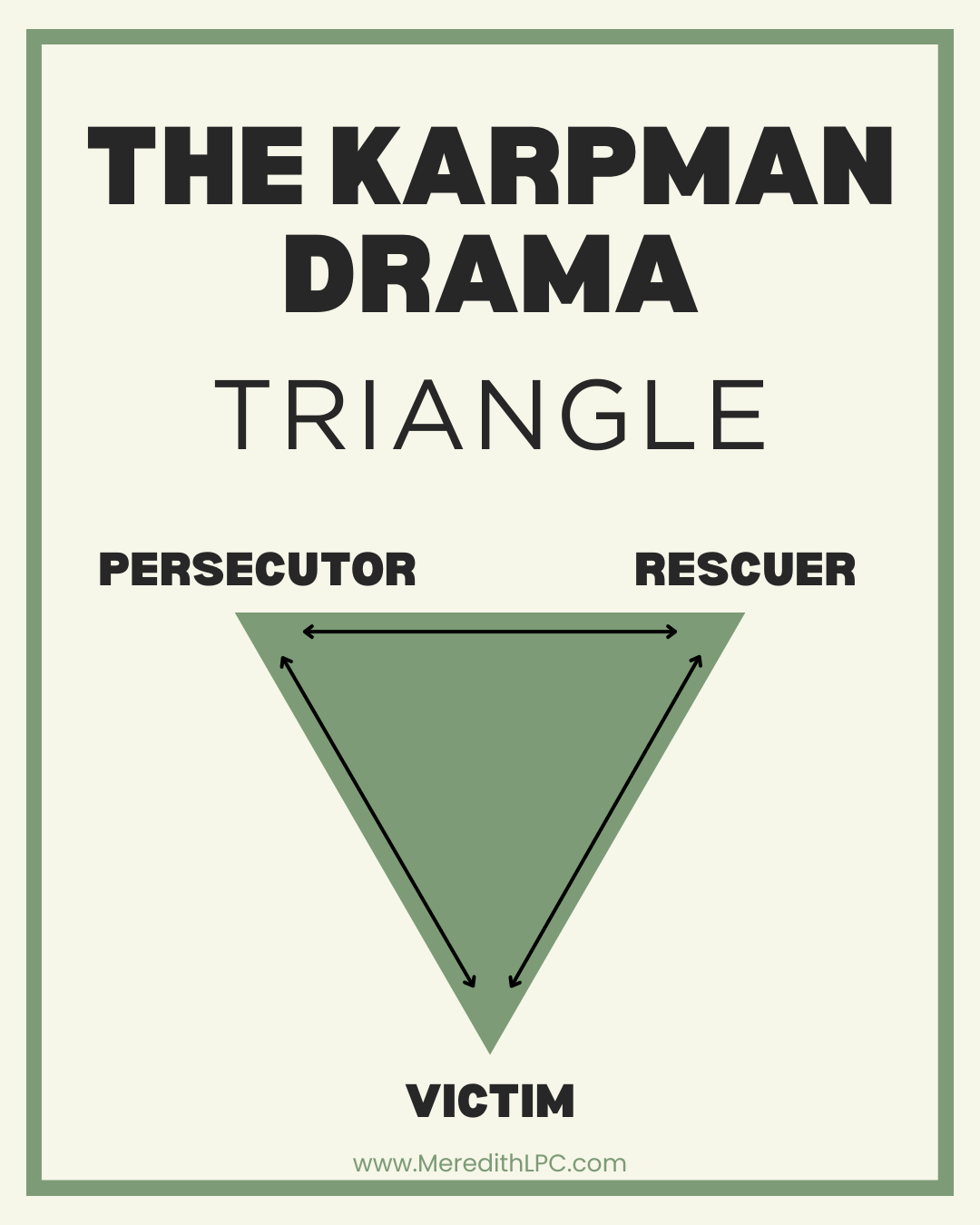
The Karpman Drama Triangle is a model that describes three common roles people take on in unhealthy or reactive relationship dynamics:
The Victim
The Rescuer
The Persecutor
These roles are not fixed identities. They are patterns of behavior we move in and out of, often without realizing it. Most people rotate between all three depending on the situation.
At its core, the triangle is driven by unmet needs, emotional reactivity, and a lack of clear boundaries.
The Three Roles (and How They Show Up)
1. The Victim: “This is happening to me”
The Victim role isn’t about someone actually being victimized. It’s about feeling powerless, stuck, or unable to change a situation.
Common thoughts:
“Nothing ever works out for me”
“I can’t handle this”
“No one understands”
How it shows up:
Avoiding responsibility or decision-making
Feeling overwhelmed and helpless
Looking for someone to “save” them
Example:
A client says, “My boss is impossible. There’s nothing I can do. I’m just stuck in this job.” While the situation may genuinely be difficult, the sense of having no agency at all is what signals the Victim role.
2. The Rescuer: “Let me fix this for you”
The Rescuer steps in to help, often with good intentions. But the help is usually unsolicited, overextended, or driven by discomfort with others’ distress.
Common thoughts:
“They can’t handle this without me”
“I should help”
“It’s my job to make this better”
How it shows up:
Giving advice that wasn’t asked for
Taking on others’ responsibilities
Feeling guilty when not helping
Example:
A friend vents about their relationship. Instead of listening, you immediately jump into problem-solving mode, texting them resources, suggesting what they should say, and checking in constantly. Later, you feel drained and maybe even resentful.
3. The Persecutor: “This is your fault”
The Persecutor is critical, blaming, or controlling. This role often emerges when someone feels overwhelmed, unappreciated, or taken advantage of.
Common thoughts:
“This is because of you”
“You never do anything right”
“Why do I have to do everything?”
How it shows up:
Harsh criticism or impatience
Controlling behavior
Frustration that comes out as anger
Example:
After repeatedly helping a partner who doesn’t follow through, the Rescuer flips into Persecutor: “You never listen. I’m done helping you.”
How the Triangle Keeps You Stuck
What makes this pattern tricky is how quickly people shift roles.
A common cycle looks like this:
Someone feels overwhelmed and steps into Victim
Another person jumps in as Rescuer
The Rescuer becomes frustrated and shifts into Persecutor
The original person now feels attacked and deepens into Victim
And the cycle continues.
These dynamics often feel familiar because they are. Many people learned these roles early in life, especially in environments where emotional needs weren’t consistently met or boundaries weren’t modeled.
Real-Life Example
Let’s say you have a sibling who often asks for financial help.
They come to you saying they’re struggling and don’t know what to do. They’re in the Victim role.
You step in and lend money, offer budgeting advice, and try to help them “get on track.” You’re in the Rescuer role.
They continue the same patterns, and you feel frustrated and used. You shift into Persecutor: “You’re irresponsible. I’m not helping you anymore.”
They feel judged and misunderstood, reinforcing their Victim role.
No one feels good in this cycle, even though everyone’s behavior makes sense in context.
Why People Get Pulled Into These Roles
There are a few common underlying drivers:
Difficulty tolerating discomfort
Watching someone struggle can feel unbearable, so we try to fix it.Learned relationship patterns
If you grew up in a household where roles were rigid, you may default to one automatically.Fear of conflict or rejection
Rescuing can feel safer than setting boundaries.Low sense of personal agency
Feeling stuck can make the Victim role feel like the only option.
How to Step Out of the Drama Triangle
Breaking these patterns doesn’t mean becoming cold or detached. It means moving toward healthier, more empowered roles.
Here’s how to start.
1. Build Awareness of Your Default Role
Start by noticing:
When do I feel most reactive?
Do I tend to over-help, shut down, or become critical?
There’s no judgment here. Awareness is the first step toward change.
2. Shift from Rescuing to Supporting
Instead of jumping in to fix things, try:
“Do you want advice or just someone to listen?”
“What do you think would help right now?”
This keeps responsibility where it belongs while still offering care.
3. Replace Victim Thinking with Agency
If you notice thoughts like “I can’t” or “There’s nothing I can do,” gently challenge them:
“What is in my control here?”
“What’s one small step I could take?”
You don’t have to solve everything. Even small shifts matter.
4. Soften Persecutor Responses
When frustration builds, pause before reacting:
What am I actually feeling underneath this anger?
What boundary do I need to set?
Often, the Persecutor role is a signal that something important hasn’t been communicated clearly.
5. Practice Clear, Direct Boundaries
Boundaries are one of the most effective ways to step out of the triangle.
Examples:
“I care about you, but I’m not able to help financially.”
“I can listen, but I’m not in a place to give advice right now.”
Clear boundaries reduce resentment and prevent role-switching.
6. Tolerate Discomfort
This is the hardest part.
Letting someone struggle without fixing it can feel uncomfortable. Setting a boundary can feel scary. Taking responsibility can feel overwhelming.
But these are the moments where real change happens.
What Healthy Dynamics Look Like Instead
When you step out of the Drama Triangle, roles shift into something more balanced:
Victim → Creator (takes ownership and seeks solutions)
Rescuer → Supporter (offers help without overstepping)
Persecutor → Assertive Communicator (expresses needs clearly without blame)
These shifts don’t happen overnight. They’re built through small, consistent changes in how you respond to yourself and others.
Final Thoughts
If you recognize yourself in any of these roles, it doesn’t mean you’re doing something wrong. It means you’ve likely been using strategies that once helped you navigate relationships, even if they no longer serve you.
The goal isn’t perfection, but awareness, choice, and a little more flexibility in how you show up.
If you find yourself stuck in these patterns despite your best efforts, therapy can be a helpful space to explore them more deeply, especially in a way that feels supportive rather than judgmental.
Related Articles: 10 Communication Skills That Can Improve Any Relationship
Mother-Daughter Dynamics: The Good, The Bad, and the Gilmore
What Is Positive Psychology? A Science-Based Approach to Well-Being
Thriving While Single: Building a Life You Love on Your Own Terms